Table of Contents
- Why Hire a Mobile Aircraft Maintenance Team
- Understanding Mobile Aircraft Maintenance Services
- AOG Maintenance Services: Emergency Response and Breakdown Assistance
- Creating an Aircraft Maintenance Compliance Checklist for Vetting
- Mobile AOG Support Team Vetting: Essential Credentials and Insurance
- Mobile Aircraft Mechanic Rates and Cost Comparison vs. FBO
- Step-by-Step Process to Hire a Mobile Aircraft Maintenance Team
- Common Mistakes to Avoid When Selecting Mobile Maintenance
Last Updated: July 13, 2026
Why Hire a Mobile Aircraft Maintenance Team
When your aircraft is grounded unexpectedly, every hour costs money. Mobile maintenance teams bring expert care directly to your aircraft, eliminating the logistics of flying to a fixed facility, losing scheduling control, or waiting days for appointments. The real advantage is control: you maintain visibility throughout the maintenance process and work with certified professionals who understand your aircraft's history and operational needs.
Key Advantages Over Fixed-Base Operations
Speed is the first advantage. Mobile teams reach you within hours for emergency repairs, not days. Routine maintenance takes the same time as an FBO but without travel logistics, deadhead flights, or fuel costs. Cost efficiency matters too: you pay only for labor and parts needed, with no facility overhead or hangar fees. Mobile services typically reduce total maintenance costs by eliminating facility surcharges and minimizing downtime. Flexibility rounds out the advantage, mobile teams work around your schedule, accommodating early mornings, evenings, and weekends, which matters especially for revenue-generating aircraft.
Understanding Mobile Aircraft Maintenance Services
Mobile aircraft maintenance means certified technicians travel to your aircraft location with tools, parts, and expertise to perform work on-site. Modern mobile teams handle complex repairs, inspections, and upgrades rivaling fixed facilities. Scope depends on certifications and equipment: basic units handle pre-flight inspections and minor repairs, while fully equipped operations perform engine work, avionics troubleshooting, structural repairs, and comprehensive annual inspections.
A&P Mechanic and IA Credentials
An A&P Mechanic (Airframe and Powerplant) is an FAA-certified technician authorized to perform maintenance, repair, and inspection on aircraft structures, engines, and systems. This baseline credential requires passing written, oral, and practical exams.
An IA (Inspection Authorization) is an additional credential held by some A&P mechanics, allowing them to sign off on annual inspections and certain major repairs. Not every A&P holds an IA. When hiring mobile maintenance professionals, verify they hold IA credentials if you need inspection authority. When vetting, ask for FAA documentation, legitimate operators provide current A&P certificates and IA ratings without hesitation.
Scope of Mobile Repair Work
Mobile teams handle routine maintenance including oil changes, filter replacements, fluid top-ups, and pre-flight inspections. They also tackle scheduled maintenance events: annual inspections, 100-hour inspections, and condition inspections, all requiring systematic documentation and FAA compliance. Avionics support, GPS updates, autopilot repairs, communication radio maintenance, and glass cockpit troubleshooting, is another common service. Engine work represents the upper end of mobile capability, from troubleshooting and minor repairs to removals and overhauls, depending on the team's equipment and certifications.
AOG Maintenance Services: Emergency Response and Breakdown Assistance
Aircraft on Ground (AOG) means your aircraft is not airworthy and cannot fly. Mobile maintenance becomes invaluable when unexpected failures ground your aircraft. AOG support means rapid diagnosis and repair, with the team arriving with diagnostic equipment, replacement parts, and expertise to identify problems quickly and work until the aircraft is airworthy again.
The cost of AOG situations is brutal. A charter operator loses several thousand dollars per day in revenue; a business owner misses critical trips; a cargo operator faces customer penalties. Mobile AOG support minimizes these losses by responding immediately and working efficiently. Verify that any mobile team actually offers round-the-clock availability, some offer daytime service with emergency-only evening/weekend response, while others maintain full staffing for genuine 24/7 coverage.
Creating an Aircraft Maintenance Compliance Checklist for Vetting
Before hiring any mobile aircraft maintenance team, use a systematic checklist to evaluate whether they meet your standards. Start with FAA compliance: every technician must hold current A&P certification, verified through FAA records or documented proof. Check that certifications are active and not suspended, and ask about inspection authorization status if you need annual inspection capability.
Insurance and liability coverage is non-negotiable. A mobile team should carry general liability insurance covering aircraft damage, property damage, and personal injury, plus errors and omissions insurance for work quality. Request certificates of insurance naming you as additional insured. Work history matters: ask for three client references, ideally aircraft owners who've used them for emergency work, and call them specifically about response time, work quality, and professionalism. Equipment and tools signal capability, a mobile team should carry diagnostic equipment appropriate to the aircraft types they service.
FAA Compliance and Logbook Documentation Standards
Every maintenance action must be documented in the aircraft logbook under FAA regulations. Each entry must include the date, technician's name and certificate number, work description, aircraft's total flight hours, and the technician's signature. For inspections, additional detail is required: inspection type, date, and any discrepancies found.
When hiring mobile maintenance professionals, confirm they understand logbook documentation requirements. Sloppy entries create problems later, invalidating warranty claims and complicating insurance disputes. Ask about their documentation process: digital or paper logbooks? How do they ensure accuracy? What's their error correction procedure? (Errors must be crossed out with a single line, never erased, and initialed with date, an FAA requirement.)
Mobile AOG Support Team Vetting: Essential Credentials and Insurance
When hiring mobile maintenance members specifically for AOG situations, vetting intensifies. You're trusting them with your aircraft when already stressed.
Verifying Certifications and Insurance Coverage
Request FAA certificates, an A&P certificate is baseline, an IA rating adds credibility for inspection work. Ask how long they've held certifications and whether they've had enforcement actions or suspensions.
Insurance verification is critical. Request a certificate of insurance showing general liability coverage (minimum $1 million recommended), aircraft liability coverage, errors and omissions coverage, and your name listed as additional insured. Call the insurance company to verify the policy is active.
Ask about their AOG response protocol: how do they staff emergency calls? Do they have technicians on-call 24/7? What's their average response time? Have them walk through a typical AOG scenario, diagnosis, parts carried, communication procedures. Request references from operators who've used them for AOG support, asking specifically about response speed, problem resolution, follow-up issues, and communication clarity.
Mobile Aircraft Mechanic Rates and Cost Comparison vs. FBO
Pricing for mobile aircraft maintenance varies based on location, complexity, and urgency. Mobile labor rates typically range by technician experience and location. Experienced A&P mechanics with IA ratings command higher rates than entry-level technicians. Emergency AOG work costs more than scheduled maintenance. Travel time affects pricing, if the team travels 100 miles, that time is billable, either at full labor rates or reduced rates depending on the team.
Parts markup varies: some teams mark up parts 10-15% to cover inventory costs, others charge parts at cost plus handling. Ask how they price parts and whether you can provide your own.
Fixed-base operators typically charge higher hourly rates but include facility overhead. A simple oil change at an FBO might cost more than mobile service because you're paying for hangar space and equipment access. However, complex work requiring specialized equipment might be cheaper at an FBO that already owns it.
The real cost comparison includes labor hours, parts and materials, travel time and mileage, facility fees, aircraft downtime, and opportunity costs. A mobile team responding in 2 hours and completing repairs in 4 hours might cost less than an FBO appointment three days away, even with lower FBO hourly rates.
| Comparison Factor | Mobile Maintenance | Fixed-Base Operator |
|---|---|---|
| Response time | Hours (24/7 available) | Days (scheduled appointments) |
| Travel costs | Included in service | None (you bring aircraft) |
| Facility overhead | Minimal | Built into pricing |
| Downtime | Minimized | Can be significant |
| Complex work capability | Varies by team | Typically full capability |
| Emergency availability | Yes (true 24/7) | Limited evening/weekend |
Step-by-Step Process to Hire a Mobile Aircraft Maintenance Team
Step 1: Assess Your Needs
Define what you need: routine maintenance, emergency support, or both? Do you need avionics, engine, or structural repair capability? Identify your service area and ask about service boundaries and travel fees.
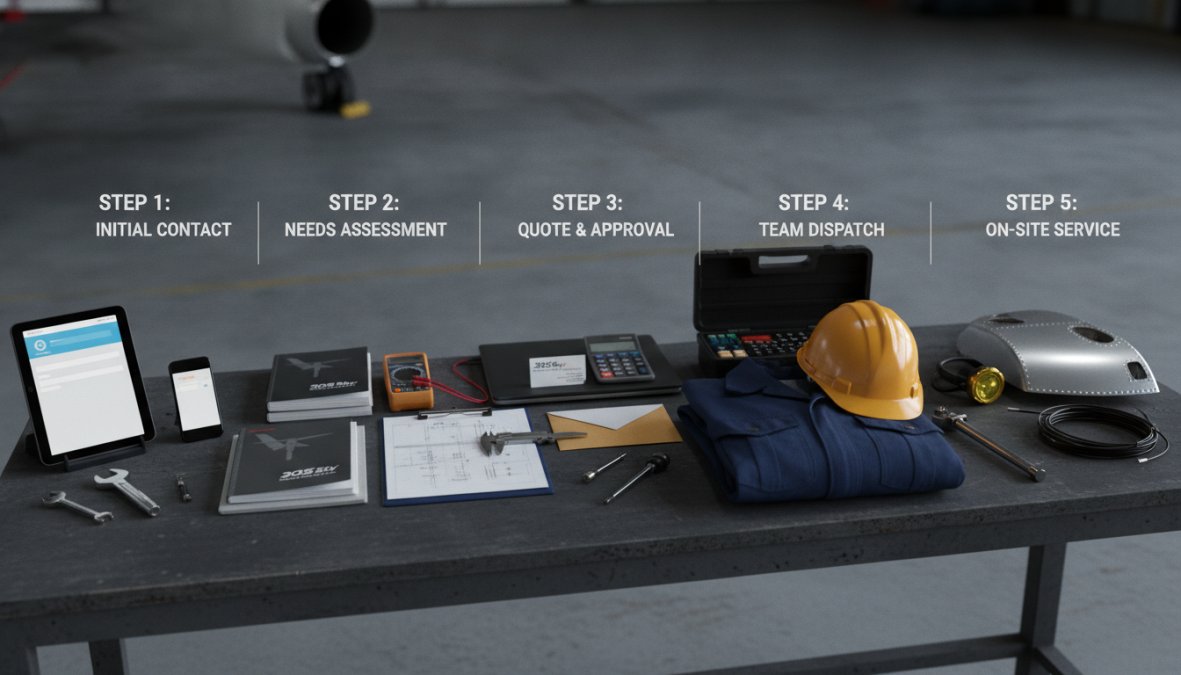
Step 2: Research and Create a Shortlist
Search aviation directories, local FBO referrals, and online reviews. Create a shortlist of three to five candidates.
Step 3: Request Information and References
Contact each team requesting FAA certificates, insurance certificates, service area maps, response time estimates, pricing structure, three client references, and equipment lists.
Step 4: Verify Credentials and Call References
Verify FAA certificates through official channels. Call the three references asking about experience, response quality, and whether they'd hire the team again.
Step 5: Compare and Select
Review all information and select your primary provider and ideally a backup.
Step 6: Establish Service Agreement
Work with your selected team to establish an agreement covering service areas, response time commitments, pricing, emergency contact procedures, logbook documentation standards, insurance requirements, and cancellation policies.
Step 7: Schedule Initial Service and Document
Schedule your first maintenance event, confirm the team understands your aircraft and requirements, and ensure they document all work properly in your logbook.
Common Mistakes to Avoid When Selecting Mobile Maintenance
Mistake 1: Hiring Based on Price Alone, The cheapest option isn't the best. A team undercutting competitors might cut corners on quality or carry insufficient insurance.
Mistake 2: Not Verifying Credentials, Verify FAA certificates independently. A technician might claim A&P certification without actually holding it.
Mistake 3: Assuming 24/7 Availability Without Confirming, Many teams claim 24/7 support but offer limited evening/weekend response. Confirm they actually staff for it.
Mistake 4: Overlooking Insurance Requirements, A team without proper insurance is a liability risk. Always verify insurance and request certificates.
Mistake 5: Not Checking References, References reveal reality. Call three clients to learn about missed deadlines or incomplete work.
Mistake 6: Failing to Establish Clear Documentation Standards, Logbook entries matter. Establish clear expectations upfront about documentation standards.
Mistake 7: Hiring Without a Service Agreement, Verbal agreements lead to misunderstandings. A written agreement clarifies expectations, pricing, response times, and procedures.
Finding the right mobile aircraft maintenance team requires systematic evaluation, but the payoff is significant. You gain access to expert care on your schedule, rapid emergency response, and lower total maintenance costs. When you hire properly credentialed, insured, and professional mobile maintenance team members, you gain peace of mind knowing your aircraft is in capable hands. 305 Sky delivers 24/7 mobile AOG support with A&P and IA-certified technicians and transparent pricing. With multiple South Florida locations and rapid response capability, 305 Sky handles everything from routine inspections to emergency engine work.
Frequently Asked Questions
What certifications should a mobile aircraft maintenance team have?
A reputable mobile aircraft maintenance team must include A&P (Airframe and Powerplant) mechanics certified by the FAA. For annual inspections and certain compliance work, at least one team member should hold an IA (Inspection Authorization) certificate. Verify current credentials through the FAA database, confirm active insurance coverage, and request references from recent clients. All team members should maintain currency with FAA regulations and aircraft-specific training.
How much does it cost to hire a mobile aircraft maintenance team?
Mobile aircraft mechanic rates depend on service type, aircraft complexity, location, and travel distance. Routine maintenance, pre-buy inspections, and emergency AOG support each have different pricing structures. For accurate quotes tailored to your aircraft and maintenance needs, contact providers directly or request pricing through their website. Many teams offer transparent pricing models and may provide cost comparisons against fixed-base operator services.
What types of aircraft maintenance can mobile teams perform on-site?
Mobile maintenance teams typically handle routine maintenance, preventative care, pre-buy inspections, annual inspections, avionics support, engine installations, and emergency AOG (Aircraft on Ground) breakdown assistance. However, scope varies by team capability and equipment. Confirm with your provider which services they offer, whether they can perform work at your location, and if they maintain proper FAA compliance and logbook documentation for all services performed.
How do I verify the credentials of a mobile AOG support team before hiring?
Request proof of A&P and IA certifications, verify insurance coverage (liability and coverage limits), check FAA database for mechanic credentials, ask for client references, confirm 24/7 availability if emergency response is critical, and review their mobile repair unit capabilities. Ensure they understand your aircraft type and can document all work in your logbook per FAA standards. A vetting checklist helps systematize this process and protects your aircraft's airworthiness and regulatory compliance.
This article was written using GrandRanker