Table of Contents
- Why Aircraft Maintenance for Corporate Fleets Matters
- Understanding FAA Regulations for Corporate Aircraft
- Managing Corporate Jet Maintenance Costs Effectively
- Selecting the Right MRO for Business Jets
- Aircraft Maintenance Software for Fleets: Tools and Technology
- Essential Maintenance Checks and Schedules
- Sustainability in Corporate Fleet Maintenance
- Building a Reliable Maintenance Program
Last Updated: July 29, 2026
Why Aircraft Maintenance for Corporate Fleets Matters
Keeping a corporate aircraft airworthy protects your investment and ensures safe operations. Aircraft maintenance represents one of the largest operational expenses operators face, yet it's often mismanaged until something breaks. At 305 Sky, we've spent over 55 years helping corporate operators understand that preventative maintenance isn't a cost center; it's a risk management strategy that directly impacts your bottom line.
A single unscheduled maintenance event can ground your aircraft for days, disrupt business operations, and cost tens of thousands of dollars in emergency repairs. Regulatory violations can result in fines, loss of operating privileges, or liability exposure. The difference between a well-maintained fleet and a reactive one comes down to whether your maintenance program is built on data-driven planning or guesswork.
Understanding FAA Regulations for Corporate Aircraft
Regulatory compliance is the foundation of any legitimate aircraft maintenance program. The FAA defines exactly what must be inspected, when, and by whom. Understanding the difference between Part 91 and Part 135 operations is critical because maintenance requirements differ significantly.
Part 91 vs. Part 135 Requirements
Part 91 covers general aviation operations, including most corporate-owned aircraft flown for business purposes. Part 135 applies to aircraft operated for compensation or hire, typically charter operations. Part 135 maintenance requirements are substantially more rigorous than Part 91, reflecting the higher risk profile of carrying paying passengers.
Under Part 91, owners are responsible for ensuring their aircraft is maintained in an airworthy condition. You must comply with all applicable airworthiness directives, service bulletins, and manufacturer recommendations, with meticulous documentation. Most Part 91 operators use annual inspections, though complex business jets demand more frequent attention.
Part 135 operators must follow a Continuous Airworthiness Maintenance Program (CAMP), which is far more structured. CAMP requires scheduled maintenance at fixed intervals, mandatory component overhauls on manufacturer-recommended schedules, and detailed record-keeping that the FAA can audit at any time.
Continuous Airworthiness Maintenance Program (CAMP)
CAMP ensures aircraft operating under Part 135 maintain consistent airworthiness standards. It's structured around scheduled maintenance events tied to flight hours, calendar days, or cycles (takeoffs and landings).
A CAMP program typically includes:
- Preflight inspections before each flight
- Line maintenance checks performed between flights
- Phase checks at regular intervals (A-checks, C-checks, depending on aircraft type)
- Component overhauls on manufacturer-recommended schedules
- Airworthiness directive compliance tracking and implementation
CAMP is proactive rather than reactive. You know exactly when maintenance is due, can plan for it, and reduce the likelihood of discovering problems mid-flight. Many corporate operators voluntarily adopt CAMP-like programs even under Part 91, because the discipline reduces risk and often lowers long-term costs.
Managing Corporate Jet Maintenance Costs Effectively
Maintenance costs typically represent 5-10% of an aircraft's annual operating budget, but can spike dramatically if you're reactive rather than proactive. The difference between a $50,000 annual maintenance bill and a $150,000 bill often comes down to whether you caught a problem early or let it fester.
Predictive Maintenance ROI Analysis
Predictive maintenance uses data, engine parameters, component condition, flight hours, and maintenance history to forecast when maintenance will be needed before something fails. Instead of following a rigid calendar-based schedule, you adjust your maintenance plan based on actual aircraft condition.
If you can avoid even one unscheduled maintenance event per year, you've likely paid for a predictive maintenance system. A typical AOG (Aircraft on Ground) emergency can cost $10,000-$50,000 depending on severity. Many operators report that implementing predictive maintenance reduces total maintenance spend by 15-25% while improving reliability.
Outsourced vs. In-House Maintenance Decision Matrix
Many corporate operators must decide whether to maintain aircraft in-house with their own technicians or contract with an external MRO. The answer depends on fleet size, maintenance complexity, capital constraints, and risk tolerance.
| Factor | In-House | Outsourced |
|---|---|---|
| Capital Requirements | High (facility, tools, equipment) | Low (contract-based) |
| Fixed Costs | High (salaries, benefits, overhead) | Variable (pay per event) |
| Flexibility | Limited (dedicated staff) | High (scale up/down) |
| Expertise Depth | Depends on your team | Access to specialists |
| Response Time | Immediate (your facility) | Dependent on provider |
| Quality Control | Direct oversight | Contractual SLAs |
In-house maintenance makes sense for large fleets (10+ aircraft) with consistent, predictable maintenance needs. Outsourced maintenance is ideal for smaller operators (1-5 aircraft) or those with irregular patterns. Many operators use a hybrid approach: routine maintenance is outsourced to a trusted MRO, while complex work is handled by specialists.
Selecting the Right MRO for Business Jets
An MRO (Maintenance, Repair, and Overhaul) provider is your partner in keeping your aircraft airworthy. Choosing the right one means expert care, predictable pricing, and rapid response when needed.
Key Criteria for MRO Selection
Your MRO should hold an FAA Part 145 certificate, which means they've been audited and approved to perform maintenance on aircraft. Look for technicians with A&P (Airframe and Powerplant) certification and inspection authorization.
Experience with your specific aircraft type is non-negotiable. Ask for references from operators flying the same equipment and actually call them. Ask about response times, quality consistency, and whether the shop has encountered problems similar to yours.
Facility and equipment matter. A well-equipped shop with modern diagnostic tools, clean environment, and organized parts management will catch problems and work efficiently. Get detailed quotes that break down labor, parts, and overhead. Understand what's included and what could drive costs up.
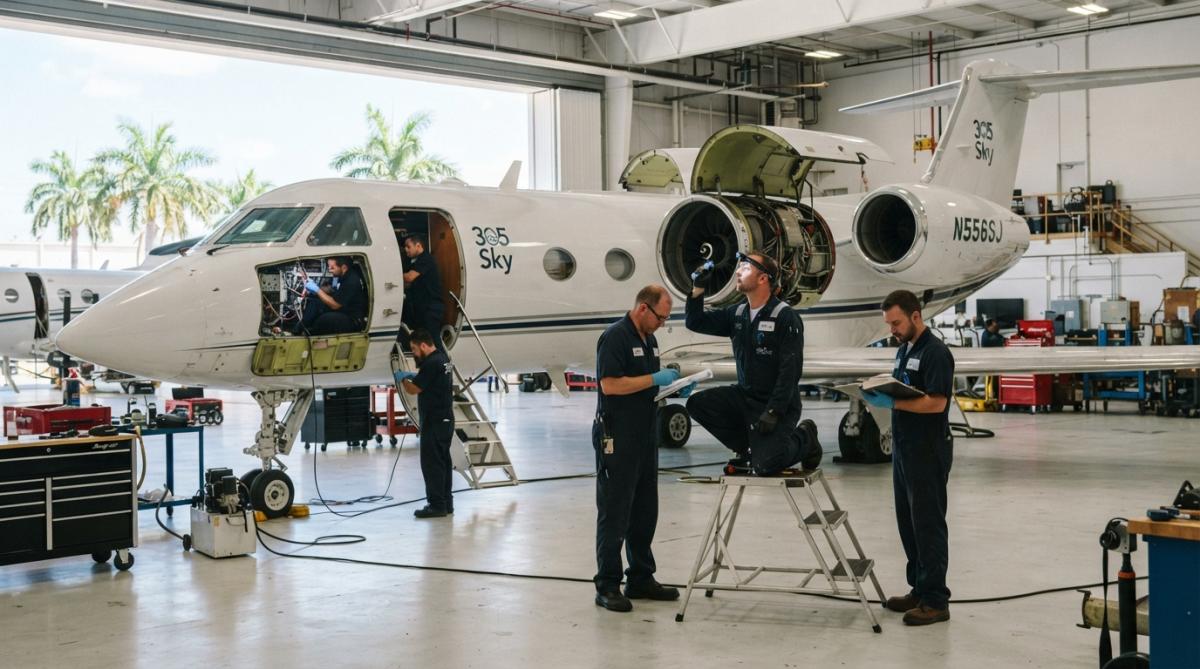
At 305 Sky, we've built our reputation on transparent pricing, rapid response, and deep expertise across multiple aircraft types. Our 24/7 AOG emergency response with mobile service van means we can reach you quickly when time matters most. We maintain four strategically located South Florida facilities to serve your aircraft whether you're based locally or passing through.
AOG Emergency Response and Supply Chain Management
AOG (Aircraft on Ground) situations are every operator's nightmare. The difference between a good MRO and a great one shows up in how they handle emergencies.
A reliable MRO maintains emergency response protocols and spare parts inventory specifically for AOG situations. They should dispatch technicians quickly, diagnose problems rapidly, and have common replacement parts available. Response time matters; the difference between a 2-hour response and an 8-hour response can mean getting back in the air the same day or being stuck overnight.
Good MROs maintain relationships with parts suppliers, OEM (Original Equipment Manufacturer) contacts, and inventory of commonly needed components. They understand that in AOG situations, expedited shipping costs are worth it if they get your aircraft flying again.
Aircraft Maintenance Software for Fleets: Tools and Technology
Modern aircraft maintenance software is the backbone of a well-organized maintenance program. It tracks what's been done, what's coming due, manages work orders, coordinates with technicians, and generates compliance reports.
Core Features to Look For
A strong maintenance management platform should include work order management, compliance tracking that alerts you when inspections or airworthiness directives are due, and inventory management for spare parts. Integration with flight operations is increasingly important; your maintenance system should automatically update maintenance intervals tied to flight hours.
Document management is essential. You need to store and retrieve maintenance records, technical manuals, service bulletins, and compliance documentation quickly. Reporting and analytics help you understand maintenance trends and make better decisions.
Several platforms serve the corporate aviation market. Veryon Tracking offers AI-infused maintenance management with compliance tracking. JSSI Traxxall provides enterprise-level tools with expert analyst support. CAMP Maintenance Management has over 55 years of expertise and supports over 20,000 aircraft. Impresa MRO unifies planning, execution, and compliance in a self-hosted platform.
Integration with Flight Operations
The most effective maintenance programs integrate tightly with flight operations. When your flight crew logs flight hours, maintenance intervals should automatically update. When a maintenance issue is discovered, it should be visible to the flight operations team. This integration reduces communication gaps and ensures maintenance planning aligns with operational needs.
Essential Maintenance Checks and Schedules
Aircraft maintenance follows a structured hierarchy of inspections, each more comprehensive than the last.
Preventative Maintenance and Minimum Equipment Lists (MELs)
Preventative maintenance includes regular inspections, component replacements on schedule, and proactive repairs based on condition monitoring. A Minimum Equipment List (MEL) is a document approved by the FAA that specifies which systems and components must be operational for your aircraft to fly.
Understanding your MEL is important because it affects maintenance planning. If something on your MEL fails, you either fix it before flying or don't fly until it's repaired. Preventative maintenance programs typically include daily preflight inspections, regular line maintenance checks, phase inspections at manufacturer-recommended intervals, component overhauls, and continuous monitoring of fluid levels and system performance.
Fleet Health Monitoring and Downtime Reduction
Fleet health monitoring uses data from your maintenance system, flight operations, and aircraft systems to give you a real-time picture of your fleet's condition. This visibility lets you make smarter decisions about which aircraft to maintain, upgrade, or replace.
Downtime reduction is a direct financial benefit of good maintenance management. By scheduling maintenance proactively, coordinating with your MRO, and maintaining spare parts inventory, you minimize unscheduled downtime and maximize aircraft availability. Many operators track their "on-time reliability," the percentage of scheduled flights that depart on time without maintenance-related delays. A well-managed fleet should achieve 95%+ on-time reliability.
Sustainability in Corporate Fleet Maintenance
Environmental responsibility is increasingly important to corporate operators. Sustainable maintenance practices reduce waste, extend aircraft life, and align with corporate ESG (Environmental, Social, Governance) goals.
Sustainable maintenance includes using environmentally approved cleaning products, recycling used fluids and components, and sourcing parts from suppliers with strong environmental practices. Predictive maintenance supports sustainability by reducing unplanned maintenance events that involve emergency shipping and expedited repairs, both energy-intensive activities.
Building a Reliable Maintenance Program
A reliable maintenance program requires the right people, processes, and systems working together.
A&P Technician Qualifications and Training
Your maintenance is only as good as the technicians performing it. A&P (Airframe and Powerplant) certification is the baseline; Inspection Authorization (IA) is an additional credential that allows technicians to sign off on annual inspections and major repairs.
Look for technicians with experience on your specific aircraft type. Continuous training is important; aviation regulations, aircraft systems, and maintenance techniques evolve. When evaluating an MRO or in-house team, ask about technician credentials, experience, and training programs.
Documentation, Compliance Audits, and Record Keeping
The FAA expects meticulous documentation. Every maintenance event should be recorded: what was done, who did it, when it was completed, and what was found. Digital record-keeping systems make this easier and allow quick retrieval of maintenance history.
Compliance audits happen periodically. Your documentation is what auditors review. A maintenance management system that generates compliance reports automatically is invaluable.
| Maintenance Element | Frequency | Documentation Required | Responsibility |
|---|---|---|---|
| Preflight inspection | Before each flight | Flight crew sign-off | Flight crew |
| Line maintenance | Between flights | Maintenance log entry | Maintenance technician |
| A-check | Every 400-600 flight hours | Detailed inspection report | A&P technician |
| C-check | Every 4,000-6,000 flight hours | Comprehensive inspection report | A&P technician with IA |
| Component overhaul | Per manufacturer schedule | Overhaul documentation | Authorized repair station |
| Airworthiness directive | As issued | Compliance documentation | A&P technician |
According to FAA [Maintenance and(/blog/routine-aircraft-inspections-importance) Alteration regulations | faa.gov], all maintenance records must be retained for as long as the aircraft is in service, plus an additional period specified by regulation. Digital systems with secure backup ensure you never lose critical documentation.
Keeping your corporate aircraft maintained properly is the foundation of safe, reliable operations. At 305 Sky, we handle the full scope of aircraft maintenance for corporate fleets with transparent pricing, 24/7 emergency response, and deep expertise across multiple aircraft types. Our 55+ years of combined aviation experience means we've seen every maintenance scenario and know how to solve it efficiently. Get a quote from 305 Sky today and discover how expert maintenance management reduces downtime and protects your investment.
Frequently Asked Questions
What are the main FAA regulations that govern aircraft maintenance for corporate fleets?
Corporate aircraft maintenance is primarily regulated under FAA Part 91 (general aviation) or Part 135 (charter/commercial operations). Part 91 operators must follow manufacturer-recommended maintenance schedules and maintain an airworthiness certificate. Part 135 operators face stricter requirements including mandatory Continuous Airworthiness Maintenance Programs (CAMP), more frequent inspections, and detailed record-keeping. Both require certified A&P technicians and adherence to Airworthiness Directives and Service Bulletins. Compliance varies based on aircraft type, mission, and operator category.
How much does it typically cost to maintain a corporate jet annually?
Corporate jet maintenance costs depend on aircraft type, flight hours, age, and maintenance program structure. Costs include scheduled inspections, parts replacement, labor, and contingency reserves. Predictive maintenance ROI analysis shows that proactive maintenance programs reduce emergency repairs and downtime. Outsourced MRO services offer transparent pricing models, while in-house programs require capital investment in facilities and staff. For accurate budgeting, request a quote from your MRO provider based on your specific fleet profile and operational needs.
What should I look for when choosing an MRO for business jets?
Key criteria include FAA certification, A&P technician credentials, OEM authorization, 24/7 AOG emergency response capability, and transparent pricing. Evaluate their experience with your aircraft type, supply chain management for hard-to-find parts, and digital record-keeping systems. Verify insurance coverage, customer references, and turnaround times for maintenance checks. Consider whether they offer integrated services, routine maintenance, avionics upgrades, cabin work, and emergency support, to minimize vendor coordination and downtime.
What is an Aircraft on Ground (AOG) event and how is it managed?
An AOG event occurs when an aircraft becomes unserviceable and cannot fly, disrupting operations and revenue. Effective AOG management requires immediate response, rapid parts availability, and qualified technicians. Leading MROs maintain 24/7 mobile response teams, extensive parts inventory, and direct relationships with suppliers to minimize downtime. Supply chain management is critical, pre-positioned spare parts, vendor agreements, and predictive maintenance reduce AOG frequency. Proper documentation through aircraft maintenance software ensures quick diagnosis and expedited repairs.
How can aircraft maintenance software improve fleet management efficiency?
Aircraft maintenance software for fleets streamlines work order creation, compliance tracking, inventory management, and maintenance scheduling. Key features include real-time aircraft health monitoring, automated Airworthiness Directive tracking, integration with flight operations for availability visibility, and secure digital record-keeping for regulatory audits. Predictive analytics help identify maintenance needs before failures occur, reducing emergency repairs. Software solutions reduce administrative burden on A&P technicians, minimize downtime through better planning, and provide transparent cost visibility for budget management.
This article was written using GrandRanker