Table of Contents
- Understanding Aircraft Maintenance Regulatory Compliance Checklist Requirements
- FAA Aircraft Maintenance Regulations and Airworthiness Directives
- Aircraft Maintenance Record Keeping Requirements and Audit Trails
- Aircraft Inspection Checklist: From Pre-Flight to Major Overhaul
- Aviation Compliance Software and Digital Transformation
- Pre-Audit Preparation and Post-Audit Remediation Workflows
- Cross-Border Regulatory Harmonization and International Standards
- Building Your Aircraft Maintenance Regulatory Compliance Checklist
Last Updated: July 27, 2026
Understanding Aircraft Maintenance Regulatory Compliance Checklist Requirements
An aircraft maintenance regulatory compliance checklist is the systematic framework that ensures every maintenance action, inspection, and repair meets federal aviation standards and preserves airworthiness throughout an aircraft's operational life. At 305 Sky, we've built our entire operation around this principle, because one missed requirement doesn't just create liability, it grounds your aircraft and destroys your schedule.
The FAA mandates that every maintenance action be documented, tracked, and verified against specific regulatory standards. Most operators treat compliance as a checkbox exercise, completing maintenance without realizing that a job completed is not the same as a job properly documented and verified against regulatory requirements.
Why Regulatory Adherence Matters for Airworthiness
Airworthiness is a legal status. An aircraft is either airworthy or it isn't, and that determination depends entirely on whether every maintenance action has been performed according to regulatory requirements and properly documented. During an accident investigation, the NTSB examines maintenance records to determine whether the aircraft was maintained according to regulatory standards. Regulatory adherence protects your operation by keeping your aircraft legally eligible to operate, creating an audit trail that proves you did everything right if something goes wrong, and forcing a systematic approach to maintenance that catches problems before they become dangerous.
FAA Aircraft Maintenance Regulations and Airworthiness Directives
Your compliance checklist must be built on FAA regulations, specifically Part 91 for general aviation operators and Part 135 for commercial operators. These regulations define what maintenance must be performed, how often, and who can perform it.
Airworthiness Directives are regulatory mandates that force immediate action when the FAA identifies a safety issue. An AD can require anything from a one-time inspection to repetitive maintenance at specific intervals to immediate grounding until a modification is completed. Service Bulletins are manufacturer-issued guidance that's often not mandatory unless the FAA incorporates them into an AD. Many operators adopt Service Bulletins proactively because they represent the manufacturer's best practice and often prevent the problems that lead to ADs.
Part 145 Certification and Maintenance Repair and Overhaul (MRO) Standards
If you're outsourcing maintenance to an external facility, that facility should be Part 145 certified. Part 145 establishes requirements for personnel qualifications, facility standards, quality control procedures, and maintenance record-keeping that go significantly beyond what Part 91 operators are required to do. Part 145 certified repair stations must have documented procedures for every maintenance task and maintain detailed records including the technician who performed the work, the specific procedures followed, any discrepancies found, and corrective actions taken. However, Part 145 certification doesn't eliminate your responsibility, your compliance checklist should include verification steps for outsourced work.
Tracking Airworthiness Directives (ADs) and Service Bulletins (SBs)
Tracking ADs is where many operators struggle. Each AD has specific compliance deadlines, sometimes measured in flight hours, calendar days, or a combination of both. Missing a deadline is a violation. Your checklist must include a systematic method for tracking every AD that applies to your aircraft by make, model, serial number, and engine types. You need to track the compliance deadline for each AD, verify that the work was performed, and document the implementation in your maintenance records. Many operators use specialized aviation compliance software for this because manual tracking is error-prone. Service Bulletins should be reviewed quarterly, assessed for applicability, and tracked even if you choose not to implement them.
Aircraft Maintenance Record Keeping Requirements and Audit Trails
Your maintenance records are your legal defense. FAA regulations require that maintenance records include the date of maintenance, the type of maintenance performed, the aircraft's total flight hours and cycles, the name of the person who performed the work, the name of the person who approved the work, and a statement that the aircraft is in airworthy condition. Records should also include details about any discrepancies found, corrective actions taken, parts replaced, and the specific maintenance procedures followed. The audit trail is critical, every change to a maintenance record should be timestamped and attributed to a specific person.
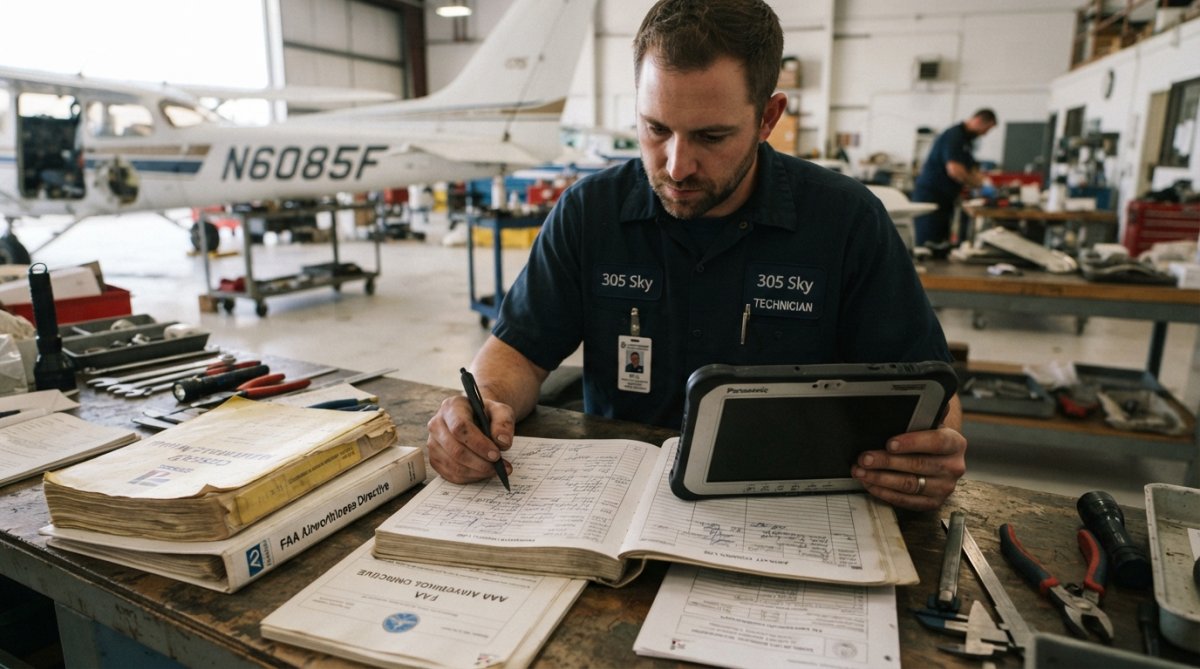
Digital records are increasingly preferable to paper logbooks. Paper records can be lost, damaged, or altered and don't scale as your operation grows. Digital records are searchable, backed up, and auditable, and they integrate with compliance tracking systems so you can verify that all required maintenance has been performed.
Component Traceability and Flight Hours Documentation
Component traceability is the ability to track every part installed on your aircraft back to its source and to know the part's maintenance history. Some components have limited service lives, an engine might be good for 3,000 hours before overhaul, a propeller might be limited to 5,000 cycles. Your maintenance records must include the part number, serial number, and installation date for every component subject to a service life limit. Flight hours and cycles are the primary metrics that drive maintenance intervals. You must track total aircraft flight hours and know your aircraft's current flight time before performing any maintenance action.
Digital vs. Paper-Based Record Systems and Compliance Monitoring
Paper-based systems have one advantage: simplicity. But simplicity comes at a cost. Paper records don't scale, are vulnerable to loss or damage, are difficult to search, and don't integrate with compliance tracking. Digital systems address these limitations. A digital maintenance logbook is searchable, backed up, and auditable. It integrates with compliance tracking so you can see at a glance which ADs are pending, which inspections are due, and which components are approaching service life limits. Many operators use a hybrid approach: digital records for day-to-day maintenance tracking and compliance monitoring, with paper backups for regulatory compliance.
Aircraft Inspection Checklist: From Pre-Flight to Major Overhaul
Your compliance checklist must cover the full spectrum of inspections, from basic pre-flight checks to major overhauls. Pre-flight inspections are the pilot's responsibility using the manufacturer's pre-flight checklist. Annual inspections are required for all general aviation aircraft and cover all major systems, verifying compliance with all ADs and that no components have exceeded their service life limits. 100-hour inspections are required for aircraft used for hire or instruction. Condition inspections are an alternative to Annuals for experimental aircraft. Progressive inspections allow operators to spread the work of an Annual across multiple smaller inspections performed between flights.
Routine Inspections, Cycle Tracking, and Inspection Intervals
Routine inspections are day-to-day checks that keep your aircraft in compliance, including oil changes, filter replacements, fluid level checks, and visual inspections of wear items. Your maintenance program must specify the interval for every routine inspection, measured in flight hours, calendar days, or both. Cycle tracking is critical for high-cycle aircraft, a cycle is one takeoff and landing. Some components are limited by cycles rather than hours. Inspection intervals are driven by the most restrictive requirement, if an engine is due at 2,000 hours but a propeller is due at 1,500 hours, the 1,500-hour interval drives the maintenance schedule.
Engine and Component Inspection Protocols with Logbook Sign-Off
Engine inspections are among the most critical maintenance actions. Engines accumulate service life with every flight hour and must be overhauled or replaced at a manufacturer-specified interval, typically 1,800 to 2,000 hours for piston engines. Before an engine overhaul is due, perform borescope inspections to assess the engine's internal condition. Every engine inspection must be documented in the maintenance records with the technician's name, date, aircraft's total flight hours, and findings. Logbook sign-off is the formal approval that an inspection has been completed and the aircraft is airworthy. An IA (Inspection Authorization) must sign off on Annual inspections. The sign-off must include the technician's name, certificate number, date, and a statement that the work was performed according to the maintenance manual and that the aircraft is in airworthy condition.
Aviation Compliance Software and Digital Transformation
Digital transformation in aircraft maintenance has shifted from optional to essential. Compliance software automates the tracking of ADs, Service Bulletins, inspection intervals, and component service life limits, eliminating manual tracking that creates errors. Modern aviation compliance software integrates maintenance logbook, AD tracking, inspection scheduling, component tracking, and audit trail management. Some platforms include work order management, allowing mechanics to see what needs to be done, record what they've done, and get approval without leaving the maintenance facility.
Real-Time Compliance Monitoring and Maintenance Scheduling
Real-time compliance monitoring shows you exactly where you stand at any moment. You can see which aircraft have inspections due in the next 30 days, which ADs are pending, which components are approaching service life limits. Maintenance scheduling integrates compliance requirements with resource availability so you can plan maintenance around your operational needs. Many operators use a rolling 90-day maintenance plan, identifying all maintenance due in the next 90 days, scheduling it, ordering parts, and allocating labor.
Cybersecurity in Digital Maintenance Records and Regulatory Updates
Digital records create cybersecurity obligations. Your maintenance records contain sensitive information about your aircraft's condition and must be protected against unauthorized access or modification. Basic cybersecurity practices include password protection, role-based access control, regular backups, and audit logging. Regulatory updates happen constantly. New ADs are issued regularly, Service Bulletins are released, and inspection intervals might be revised. Your compliance system must allow you to incorporate these updates quickly.
Pre-Audit Preparation and Post-Audit Remediation Workflows
Audits happen regularly. The FAA conducts ramp checks, insurance companies conduct audits before renewing your policy, and Part 135 operators face regular FAA audits. Pre-audit preparation means reviewing your maintenance records for completeness, ensuring all ADs have been implemented and documented, verifying that all inspections are current, and checking that all logbook entries are signed by appropriately certified personnel. Post-audit remediation is what you do when an auditor finds non-compliance findings. Your response must address each finding with a Corrective Action Plan that explains what went wrong, what you've done to fix it, and what you're doing to prevent it from happening again.
Quality Assurance (QA) Procedures and Non-Compliance Findings
Quality Assurance is a systematic approach to ensuring that maintenance is performed correctly and documented completely. A QA program includes regular audits of your own maintenance records, spot checks of completed work, and periodic reviews of your maintenance procedures. Many operators designate someone as their quality control person to review maintenance records for completeness and verify that work was performed according to the maintenance manual.
Corrective Action Plans and Risk Mitigation Strategies
A Corrective Action Plan (CAP) is your formal response to an audit finding. It should explain what happened, why it happened, what you've done to correct it, and what you're doing to prevent it from happening again. Effective CAPs address root causes rather than symptoms. Risk mitigation strategies are the broader changes you make to prevent future non-compliance.
Cross-Border Regulatory Harmonization and International Standards
If you operate internationally, you need to understand that different countries have different aviation authorities and different regulatory requirements. However, there's significant harmonization happening. ICAO (International Civil Aviation Organization) establishes international standards that most countries follow.
EASA, ICAO, and National Aviation Authority (NAA) Alignment
EASA (European Aviation Safety Agency) issues ADs for European-registered aircraft. These ADs often parallel FAA ADs, though EASA sometimes issues ADs that the FAA doesn't or issues them on different timelines. ICAO provides guidance on maintenance standards through Annex 8 (Airworthiness of Aircraft). If you operate internationally, you might need to comply with multiple regulatory frameworks simultaneously. Your maintenance program must track ADs from all applicable authorities and implement whichever is most restrictive.
Building Your Aircraft Maintenance Regulatory Compliance Checklist
Building an effective compliance checklist is a structured process. You start by understanding your regulatory obligations, then document your maintenance program, then create the specific checklists that guide day-to-day maintenance work. Your regulatory obligations depend on your aircraft type, operation type, and where you operate. Once you understand your obligations, document your maintenance program, a written document that specifies the type of aircraft you operate, the inspection program you follow, the intervals for routine maintenance, how you track ADs and Service Bulletins, how you manage components with service life limits, and how you maintain records.
Step-by-Step Implementation and Standard Operating Procedures (SOP)
Implementation starts with identifying all applicable ADs for your aircraft by searching the FAA's AD database with your aircraft's make, model, and serial number. Next, establish inspection intervals by reviewing the manufacturer's maintenance manual and documenting intervals for every routine inspection. Third, establish component tracking by documenting installation dates, total time before installation, and service life limits for every component with a service life limit. Fourth, establish a record-keeping system, decide whether to use paper or digital records and establish procedures for what information must be recorded. Standard Operating Procedures (SOPs) are the detailed instructions that guide maintenance work. Your SOPs should be based on the manufacturer's maintenance manual but adapted to your specific operation.
Human Factors and Procedural Compliance Training
Human factors are the biggest source of maintenance errors. A mechanic might skip a step because they're in a hurry, forget to perform a verification check, or misunderstand a procedure. Training and procedures reduce these errors. Procedural compliance training teaches mechanics exactly how to follow your SOPs. Your training program should include initial training for new mechanics and recurrent training covering new procedures, lessons learned, and regulatory updates. Fatigue is a human factor that's often overlooked. A tired mechanic makes more mistakes. Schedule maintenance requiring concentration and precision when mechanics are fresh.
| Implementation Phase | Duration | Key Deliverables | Responsibility |
|---|---|---|---|
| Regulatory Review | 1-2 weeks | Identify applicable ADs, establish inspection intervals, document maintenance program | Maintenance Manager |
| System Selection | 2-4 weeks | Choose record-keeping system, establish procedures | Operations Manager |
| Checklist Development | 3-4 weeks | Create maintenance checklists, SOPs, training materials | Maintenance Director |
| Staff Training | 2-4 weeks | Train mechanics on procedures, record-keeping, compliance requirements | Training Coordinator |
| Audit & Refinement | Ongoing | Conduct internal audits, identify gaps, refine procedures | Quality Assurance |
Building and maintaining an aircraft maintenance regulatory compliance checklist is an ongoing commitment to systematic compliance. The operators who stay ahead of regulatory issues are the ones who have documented processes, real-time visibility into their compliance status, and a culture that treats compliance as a core operational value rather than a burden.
At 305 Sky, we've spent 55 years helping operators across South Florida manage exactly this challenge. We maintain comprehensive digital records for every aircraft we service, track ADs and Service Bulletins in real-time, and ensure that every maintenance action is documented to regulatory standards. Our 24/7 AOG response capability means you're never stuck without immediate support, whether you need emergency maintenance at 2 AM or a pre-purchase inspection before closing on a new aircraft. We handle the compliance complexity so you can focus on flying. Get a Quote and let us show you how transparent, expert aircraft maintenance actually works.
Frequently Asked Questions
What FAA regulations apply to aircraft maintenance records and how often should they be audited?
The FAA requires all aircraft maintenance records be retained and accessible per Part 91 and Part 145 standards. Records must document all maintenance performed, including flight hours, cycle tracking, and component traceability. Audits should occur annually or per your Safety Management System (SMS) schedule. Digital compliance monitoring systems help track inspection intervals and ensure regulatory adherence without gaps.
What are the key components of an aircraft maintenance record keeping system?
Essential components include: flight hours and cycle documentation, logbook sign-offs by certified technicians, Airworthiness Directive (AD) and Service Bulletin (SB) compliance records, component inspection protocols with dates and findings, corrective action plans for non-compliance findings, and audit trails showing who accessed records and when. Many operators now use aviation compliance software for real-time compliance monitoring and secure digital transformation.
How do I create an effective aircraft inspection checklist for regulatory compliance?
Start with your aircraft type's manufacturer maintenance manual and overlay FAA/EASA requirements. Include routine pre-flight checks, scheduled inspection intervals, engine and component inspection protocols, and cycle-based maintenance triggers. Document each inspection with technician sign-off, findings, and any corrective actions. Use Standard Operating Procedures (SOP) to ensure consistency. Digital tools enable real-time maintenance scheduling and compliance monitoring across your fleet.
What is aviation compliance software and how does it help with regulatory adherence?
Aviation compliance software automates maintenance scheduling, tracks inspection intervals, manages Airworthiness Directives, and maintains digital audit trails for regulatory audits. Key features include real-time compliance monitoring, component traceability, corrective action plan workflows, and cybersecurity protections for sensitive maintenance records. This digital transformation reduces human error, speeds post-audit remediation, and ensures your operation meets FAA, EASA, and international NAA standards.
What happens during a pre-audit preparation for aircraft maintenance compliance?
Pre-audit preparation involves reviewing all maintenance records for completeness, verifying logbook sign-offs are present and legible, confirming all Airworthiness Directives and Service Bulletins are documented, checking component traceability and flight hours accuracy, and identifying any non-compliance findings. Quality Assurance (QA) procedures should validate inspection intervals were met and corrective action plans were executed. Digital compliance software streamlines this process by generating audit-ready reports automatically.
How do I handle non-compliance findings and create an effective corrective action plan?
When non-compliance findings occur, document the issue, root cause, and immediate risk mitigation steps. Your corrective action plan should assign responsibility, set completion dates, and outline how compliance will be restored. Implement preventive measures to avoid recurrence. Update your Standard Operating Procedures (SOP) if needed. Digital systems track corrective actions through completion, providing auditors with evidence of timely remediation and reduced operational risk.
What cybersecurity measures should protect my aircraft maintenance records?
Implement role-based access controls so only authorized personnel view maintenance data. Use encryption for digital records in transit and at rest. Maintain audit trails showing who accessed records and when. Conduct regular backups and disaster recovery testing. Ensure your aviation compliance software meets FAA cybersecurity standards. Train staff on data protection protocols. Regular security updates and compliance monitoring help prevent unauthorized access to sensitive technical records.
This article was written using GrandRanker