Table of Contents
- Understanding Private Aviation Maintenance Standards 2026
- FAA Private Aircraft Maintenance Regulations and Requirements
- Types of Maintenance Inspections: A, B, C, and D Checks
- Cost of Private Jet Maintenance and Budget Planning
- Aircraft Maintenance Software and Digital Compliance Tools
- Private Aviation Safety Standards and Certification
- Real-World Maintenance Challenges and Solutions for 2026
- Future of Private Aviation Maintenance: Beyond 2026
Last Updated: July 26, 2026
Understanding Private Aviation Maintenance Standards 2026
Private aviation maintenance standards 2026 represent the evolving regulatory framework and industry best practices that keep aircraft safe, compliant, and operationally reliable. At 305 Sky, we've spent over 55 years navigating these standards with our clients across South Florida. The landscape has shifted considerably, what worked five years ago isn't sufficient anymore. The FAA continues to tighten requirements around airworthiness, scheduled maintenance intervals, and documentation.
What separates a well-maintained aircraft from one constantly fighting compliance issues is treating maintenance as a strategic investment rather than a cost center. Private aviation maintenance standards aren't just regulatory checkboxes; they're the foundation of safety, asset value, and operational continuity.
FAA Private Aircraft Maintenance Regulations and Requirements
The Federal Aviation Administration sets the baseline for all maintenance in U.S. airspace through three regulatory frameworks: 14 CFR Part 43, 14 CFR Part 91, and 14 CFR Part 135.
14 CFR Part 43 defines how maintenance must be performed, establishing requirements for maintenance, preventive maintenance, rebuilding, and alteration of aircraft. Every mechanic must follow Part 43 protocols, including documentation standards and inspection procedures.
14 CFR Part 91 applies to general aviation operators; most private aircraft owners fall here. Part 91 mandates that aircraft remain airworthy and that owners conduct required maintenance. It specifies inspection intervals, Airworthiness Directives compliance, and record-keeping obligations. Your aircraft must undergo an annual inspection at minimum, or if you operate under a continuous airworthiness maintenance program (CAMP), inspections follow that program's schedule.
14 CFR Part 135 governs commercial air taxi and charter operations. If you're flying paying passengers, maintenance requirements become significantly more rigorous, with tighter inspection intervals and detailed documentation.
Airworthiness Directives (ADs) are mandatory compliance items issued by the FAA when a safety defect is discovered. ADs can require inspection, repair, replacement, or modification. Ignoring an AD grounds your aircraft.
Types of Maintenance Inspections: A, B, C, and D Checks
Aircraft maintenance follows a tiered inspection system. The deeper the check, the more comprehensive the inspection and the longer your aircraft will be out of service.
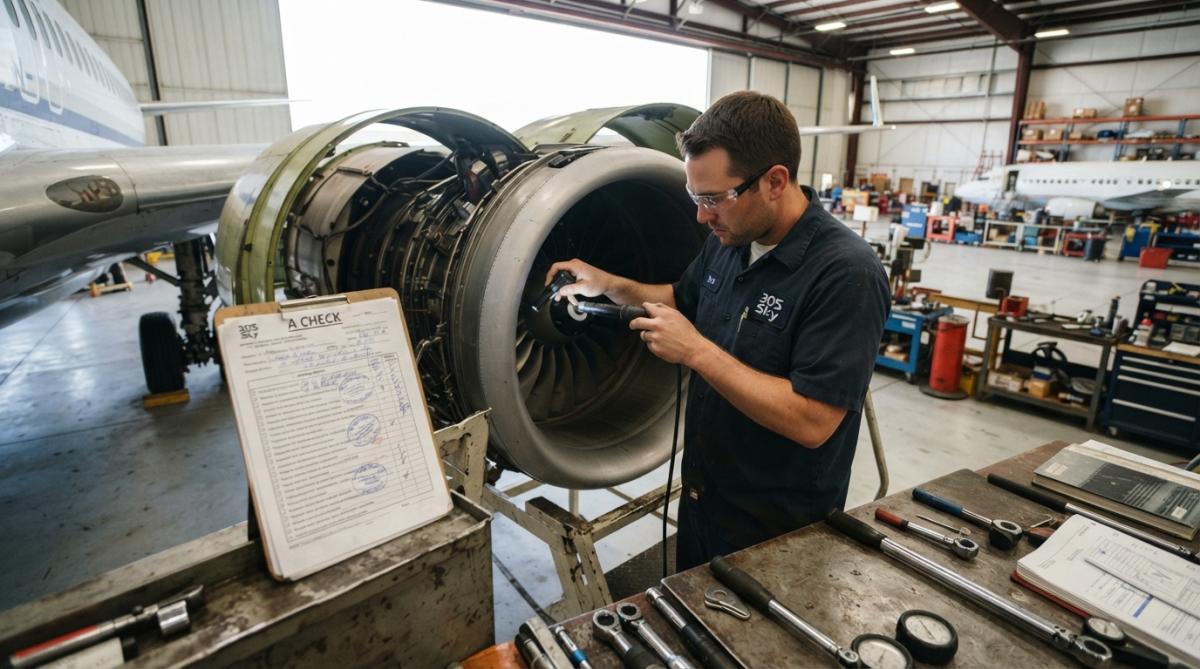
A Checks occur every 400-600 flight hours (or annually, whichever comes first). They typically take 20-40 hours and cover basic inspections of engines, systems, and structure, including fluid levels, filter inspection, and control surface checks. Most A Checks happen overnight or over a weekend.
B Checks occur at longer intervals, typically every 4-8 years or 800-1,200 flight hours, requiring 50-150 hours of work. These include more thorough inspection of engines, airframe components, and system functionality, with panel removal and comprehensive testing.
C Checks happen every 4-6 years or 1,200-2,000 flight hours, requiring 200-400 hours and grounding your aircraft for several days. This inspection covers structural integrity, corrosion assessment, and detailed examination of critical systems.
D Checks are the most comprehensive, occurring every 6-10 years or 3,000-5,000 flight hours. A D Check is essentially a complete teardown and rebuild, requiring 2,000+ hours and grounding your aircraft for 4-8 weeks. For heavy jets, a D Check can cost hundreds of thousands of dollars.
| Check Type | Frequency | Typical Duration | Hours Required | Scope |
|---|---|---|---|---|
| A Check | 400-600 hrs / annually | Overnight to 2 days | 20-40 | Basic systems, fluids, controls |
| B Check | 4-8 years / 800-1,200 hrs | 2-3 days | 50-150 | Deeper system inspection, panel removal |
| C Check | 4-6 years / 1,200-2,000 hrs | 3-5 days | 200-400 | Structural integrity, corrosion, critical systems |
| D Check | 6-10 years / 3,000-5,000 hrs | 4-8 weeks | 2,000+ | Complete teardown, comprehensive rebuild |
Scheduled vs. Unscheduled Maintenance represents the split between planned and reactive work. Scheduled maintenance follows manufacturer recommendations and your maintenance program. Unscheduled maintenance occurs when something breaks or a problem is discovered during inspection. Preventive maintenance catches issues before they become failures.
Cost of Private Jet Maintenance and Budget Planning
Maintenance costs vary dramatically based on aircraft category, age, and use.
Light Jets typically run $3,000-$5,000 per flight hour in direct operating costs, with maintenance comprising roughly 30-40% of that. An annual A Check might cost $15,000-$25,000. A C Check could run $75,000-$150,000. At 400 annual flight hours, budget $36,000-$60,000 in scheduled maintenance alone, plus reserves for unscheduled work.
Mid-Size Jets fall into the $4,000-$7,000 per flight hour range, with maintenance running 35-45% of total operating costs. Annual maintenance might cost $25,000-$40,000. A C Check could reach $200,000-$350,000. At 500 annual flight hours, plan on $50,000-$75,000 in scheduled maintenance.
Heavy Jets are the most expensive to maintain. Direct operating costs run $8,000-$15,000 per flight hour, and maintenance comprises 40-50% of that. Annual inspections might cost $50,000-$100,000. A D Check regularly exceeds $1,000,000. At 300 annual flight hours, budget $120,000-$180,000 in scheduled maintenance, before any major events.
The real challenge is planning for the unexpected. A failed engine component, structural corrosion, or avionics malfunction can add $50,000 to $500,000 to your annual budget overnight.
When your aircraft breaks down unexpectedly, you need immediate response. A shop offering 24/7 maintenance support with mobile maintenance capability is essential insurance against extended downtime.
Aircraft Maintenance Software and Digital Compliance Tools
Digital CAMO (Continuous Airworthiness Maintenance Organization) systems and engine health monitoring platforms have become essential for compliance and operational efficiency.
Digital CAMO Systems automate compliance tracking, alert you to upcoming inspections, and maintain complete digital records of every maintenance action. These platforms integrate with your aircraft's avionics to pull real-time flight data, automatically calculate maintenance intervals, and flag Airworthiness Directives specific to your aircraft. A strong CAMO system prevents accidental operation with outstanding ADs, ensures no inspection gets missed, and generates the documentation the FAA expects during audits.
Engine Health Monitoring (EHM) systems track engine parameters continuously, oil temperature, turbine inlet temperature, fuel flow, and dozens of other metrics. These systems establish a baseline for your specific engine and alert your maintenance team when parameters drift outside normal ranges. Instead of waiting for an inspection to discover deterioration, you know in advance that a component is showing early signs of wear, allowing you to schedule replacement during planned maintenance rather than facing emergency failure.
Record-Keeping and Documentation is where many operators stumble. The FAA requires meticulous records: maintenance logs, inspection reports, parts records, repair documentation, and AD compliance evidence. Digital systems organize this chaos, logging every maintenance action with date, technician signature, parts used, and work performed. When the FAA audits your operation, you pull a comprehensive digital record demonstrating your commitment to airworthiness.
Private Aviation Safety Standards and Certification
Safety in private aviation extends beyond regulatory compliance through third-party audits and certifications.
IS-BAO (International Standard for Business Aircraft Operations) is the gold standard for safety management systems, establishing 42 standards across operations, maintenance, training, and safety culture. Achieving IS-BAO certification requires implementing a comprehensive Safety Management System (SMS) that goes beyond regulatory minimums, identifying hazards, managing risk, and creating a culture where safety concerns are reported and addressed systematically.
Wyvern Wingman and ARGUS Platinum are third-party auditing services that evaluate operators against industry best practices. These audits assess maintenance practices, crew training, operational procedures, and safety culture. Charter companies and fractional ownership programs often require their operators to maintain these certifications.
A&P Mechanics and Technician Certifications are the human foundation of maintenance excellence. An Airframe and Powerplant (A&P) mechanic has demonstrated technical knowledge and practical competency. A technician with 20 years on business jets catches subtle problems that someone with 2 years might miss. When entrusting your aircraft to a maintenance shop, the credentials of the mechanics matter as much as the shop's certifications.
Real-World Maintenance Challenges and Solutions for 2026
Corrosion Control and Structural Integrity become increasingly critical as aircraft age. Salt air, particularly relevant in South Florida, accelerates corrosion. Small cracks in fasteners or welds can propagate under stress. Modern maintenance uses advanced diagnostic tools, ultrasonic thickness testing, eddy current inspection, and thermography, to detect issues before they become critical. Skimping on corrosion inspection is false economy; a structural failure in flight is catastrophic.
Supply Chain Pressures and Labor Shortage Impact are reshaping maintenance timelines. Aircraft parts can take 8-12 weeks to arrive. Labor shortages mean experienced mechanics are in high demand, and scheduling a major inspection can require booking months in advance. Plan your maintenance further ahead than you used to. Book your C Check 6 months in advance and identify long-lead parts early.
Future of Private Aviation Maintenance: Beyond 2026
Sustainable Aviation Maintenance and Environmental Standards are emerging as regulatory and market pressures increase. The FAA and EASA are developing standards around emissions reduction, noise abatement, and sustainable aviation fuel (SAF) compatibility. Maintenance protocols are evolving to support these goals, ensuring engines run efficiently and reducing waste in maintenance operations.
Predictive Maintenance Technology and Advanced Diagnostics will reshape how maintenance is planned. Machine learning algorithms will analyze historical maintenance data, flight patterns, and component performance to predict failures before they occur. Instead of replacing components on a fixed schedule, you'll replace them when data indicates they're approaching end-of-life. This shift from calendar-based to condition-based maintenance will reduce unnecessary part replacements, lower maintenance costs, and improve aircraft availability.
Maintenance Standards Summary and Key Takeaways
| Standard/Framework | Purpose | Key Requirement |
|---|---|---|
| 14 CFR Part 43 | Defines how maintenance is performed | Mechanics must follow documented procedures, maintain records |
| 14 CFR Part 91 | General aviation compliance | Annual inspection or CAMP program, AD compliance, airworthiness |
| 14 CFR Part 135 | Commercial operations | FAA-approved maintenance program, tighter inspection intervals |
| Airworthiness Directives (ADs) | Safety compliance | Mandatory inspection, repair, or replacement when issued |
| IS-BAO Certification | Safety management excellence | Implement SMS, exceed regulatory minimums, third-party audit |
| A/B/C/D Checks | Tiered inspections | Scheduled at specific intervals based on flight hours and calendar time |
Aircraft owners and operators who treat maintenance as a strategic priority maintain safer, more reliable, and more valuable aircraft. They stay ahead of regulatory changes, catch problems early, and avoid catastrophic costs of unscheduled failures.
At 305 Sky, we've built our reputation on this principle. Our 24/7 AOG response, digital compliance tracking, and team of experienced A&P mechanics ensure your aircraft remains fully airworthy and compliant with all 2026 standards. We handle routine inspections, emergency repairs, avionics upgrades, and everything in between, all with the transparency and family-oriented service that's defined our South Florida operation for over 55 years.
Frequently Asked Questions
What are the FAA regulations for private jet maintenance in 2026?
Private jet maintenance in 2026 continues to be governed by 14 CFR Part 43, Part 91, and Part 135, depending on whether your aircraft is owner-operated or commercially managed. Part 91 requires aircraft to maintain an Airworthiness Certificate and comply with Airworthiness Directives issued by the FAA. Scheduled maintenance, preventive inspections (A, B, C, D checks), and record-keeping are mandatory. Operators must also follow manufacturer-recommended maintenance intervals and use certified Airframe and Powerplant (A&P) mechanics for major repairs and inspections.
How often do private jets need maintenance inspections?
Maintenance frequency depends on aircraft type, flight hours, and manufacturer specifications. A-checks typically occur every 400-600 flight hours or annually. B-checks happen every 4-6 years or 1,200-2,000 flight hours. C-checks occur every 4-10 years or 4,000-6,000 flight hours. D-checks (major overhauls) are required every 6-10 years or 10,000+ flight hours. Light jets may have different intervals than mid-size or heavy jets. Your aircraft manufacturer and maintenance program will specify exact intervals to maintain compliance and safety.
What aircraft maintenance software should private jet owners use?
Modern aircraft maintenance software includes digital CAMO systems (Continuous Airworthiness Maintenance Program management), Engine Health Monitoring (EHM) platforms, and integrated record-keeping tools. These systems track scheduled maintenance, Airworthiness Directives, flight hours, and compliance documentation. Leading options provide real-time alerts for upcoming inspections, secure digital records for regulatory audits, and predictive maintenance insights. Your choice depends on fleet size, aircraft type, and whether you operate under Part 91 or Part 135. Consult with your maintenance provider to select software that integrates with your operational needs.
What are the key differences between private aviation safety standards and regulations?
Regulations like 14 CFR Part 43 and Part 91 are mandatory FAA requirements. Safety standards go beyond compliance, they include third-party audits (IS-BAO, Wyvern Wingman, ARGUS Platinum), Safety Management Systems (SMS), and best practices for operational risk reduction. While regulations establish minimum maintenance intervals and documentation, safety standards evaluate your entire maintenance culture, technician qualifications, and continuous improvement processes. Operators seeking insurance discounts or charter certification often pursue these voluntary safety certifications to demonstrate higher standards than the FAA minimum.
Can private jet owners perform their own maintenance?
Owner-performed maintenance is limited under 14 CFR Part 43. Owners of non-commercial aircraft can perform preventive maintenance tasks like oil changes, filter replacements, and minor inspections if they hold a valid pilot certificate. However, all major repairs, component overhauls, and annual inspections must be performed by certified Airframe and Powerplant (A&P) mechanics or repair stations. Commercial operators under Part 135 cannot perform their own maintenance, all work must be completed by certified personnel. Always consult your aircraft manufacturer and maintenance manual to determine what tasks qualify as owner-performed.
What should I expect from a pre-purchase inspection (PPI) for a private aircraft?
A comprehensive pre-purchase inspection examines the airframe, engines, avionics, control systems, and all documentation. Certified A&P mechanics review maintenance records, Airworthiness Directives compliance, corrosion issues, and structural integrity. The inspection includes engine borescope analysis, systems testing, and a detailed report identifying any deferred maintenance or safety concerns. Costs and turnaround time vary by aircraft type and condition. A thorough PPI protects your investment by revealing hidden problems before purchase and helps you negotiate fair pricing based on the aircraft's true maintenance status.
How do I ensure my maintenance provider meets private aviation safety standards?
Verify that your maintenance provider employs certified A&P mechanics, holds appropriate FAA certifications (Part 145 repair station or equivalent), and maintains detailed records of all work performed. Ask about their Safety Management System (SMS), compliance with Airworthiness Directives, and participation in third-party audits (IS-BAO, Wyvern, ARGUS). Request references from other operators and confirm their 24/7 AOG (Aircraft on Ground) emergency response capabilities if needed. A transparent, family-oriented provider will openly share certifications, insurance coverage, and a track record of regulatory compliance and customer satisfaction.
Ready to ensure your aircraft meets 2026 maintenance standards? Contact 305 Sky for a comprehensive maintenance assessment. We'll review your current program, identify any compliance gaps, and build a plan that keeps your aircraft mission-ready while minimizing downtime and surprises. Get a Quote.
This article was written using GrandRanker