Table of Contents
- 1. Establish a Strict Routine Maintenance Schedule
- 2. Implement Digital Aircraft Maintenance Tracking Software
- 3. Prioritize Corrosion Prevention and Airframe Inspection
- 4. Understand FAA Aircraft Maintenance Requirements and Compliance
- 5. Budget for Unexpected Repairs and Plan Maintenance Costs
- Bonus Tip: Pre-Flight Inspections and Avionics Maintenance
- Conclusion
Last Updated: August 10, 2026
New jet ownership comes with excitement and responsibility. The difference between a well-maintained aircraft and one headed for costly repairs often comes down to one thing: how seriously you take aircraft maintenance tips from day one. At 305 Sky, we've guided hundreds of new owners through their first year of aircraft ownership, and the pattern is clear. Those who establish strong maintenance habits early avoid emergency repairs, maintain regulatory compliance, and protect their aircraft's resale value. Those who don't? They face unexpected downtime, regulatory headaches, and depreciating assets.
This guide covers the five most critical aircraft maintenance tips for new jet owners, the practices that separate responsible operators from those learning expensive lessons the hard way. We'll walk through each one with specific actions you can take today.
1. Establish a Strict Routine Maintenance Schedule
The foundation of aircraft ownership is predictability. Your jet doesn't care when you want to fly it, it cares about what maintenance it needs and when. Skipping scheduled maintenance doesn't save money; it defers costs until they become emergencies.
The FAA requires two primary maintenance intervals for most aircraft: annual inspections and 100-hour checks. These aren't suggestions. They're regulatory requirements that determine whether your aircraft is airworthy.
Understanding Annual Inspections and 100-Hour Checks
An annual inspection is exactly what it sounds like: a comprehensive examination of your aircraft's systems, structure, and components performed once every calendar year. A qualified inspector (called an Inspection Authorization, or IA) must conduct it. This inspection covers everything, engine compression, hydraulic systems, avionics, structural integrity, and compliance with all applicable airworthiness directives.
The 100-hour check is less stringent but more frequent. It occurs every 100 hours of flight time (whichever comes first between the 100-hour mark and annual). Many owners combine their 100-hour check with their annual to simplify the process, but the 100-hour check is still a separate, mandatory event if your aircraft flies regularly.
New owners often underestimate how quickly 100 hours accumulates. A jet flying 3-4 times weekly hits 100 hours in roughly 6-8 months. If you're an active operator, you'll be scheduling maintenance constantly. That's not a bug, it's the reality of ownership.
Engine Oil Changes and Filter Replacements
Engine oil analysis and changes are where many new owners make their first mistake: they assume oil changes follow a time-based schedule like a car. They don't.
Aircraft engines run on condition-based maintenance for oil. You change the oil and filter when the engine oil analysis indicates it's time, not on a calendar. This typically happens every 25-50 flight hours, depending on engine type, operating conditions, and what the oil analysis reveals.
That's where oil analysis programs become essential. Services like ALS Tribology Aviation Oil Analysis and Pratt & Whitney's Advanced Oil Analysis Technology provide early warning systems for engine wear. They analyze microscopic particles in your oil to detect component deterioration before it becomes catastrophic. A chip in the oil might indicate bearing wear. Elevated iron content might signal piston ring issues.
New owners who skip oil analysis programs are essentially flying blind. They change oil on a guess and miss early warning signs that could prevent engine failure.
2. Implement Digital Aircraft Maintenance Tracking Software
Paper logbooks are history. If you're still managing your aircraft's maintenance records with physical logs, you're creating liability, compliance risk, and operational inefficiency.
Digital maintenance tracking software transforms how you manage compliance, schedule work, and prove airworthiness to regulators, insurers, and potential buyers.
Moving From Paper Logbooks to Cloud-Based Systems
A paper logbook is a single point of failure. It can be lost, damaged, or, in the worst case, discovered to have incomplete records during an FAA audit. Digital logbooks stored in the cloud solve this problem.
Platforms like Bluetail, Veryon Tracking, and PLANELOGIX digitize your entire maintenance history, making records instantly searchable and permanently backed up. When an inspector needs to verify that an airworthiness directive was completed, you pull it up in seconds instead of flipping through pages.
Digital systems also enforce compliance automatically. They flag when your annual inspection is due, alert you to service bulletins relevant to your aircraft, and create audit trails showing exactly who performed what work and when.
The transition from paper to digital typically takes 2-4 weeks if your records are organized. If they're scattered across multiple logbooks, it takes longer. But the investment pays for itself the first time you avoid a compliance violation.
Real-Time Compliance and Service Bulletin Alerts
Service bulletins are manufacturer recommendations for maintenance or modifications. They're not always mandatory, but the FAA can make them mandatory through an airworthiness directive. The problem: there are hundreds of service bulletins for any given aircraft, and tracking which ones apply to you is nearly impossible with paper records.
Digital platforms like Veryon Tracking monitor your aircraft type and alert you when new service bulletins are released. They track which ones you've completed and flag those that are pending. This prevents the scenario where an inspector discovers you've missed a critical service bulletin that's since become an airworthiness directive.
Real-time alerts also mean you're never surprised by compliance requirements. You know what's coming and can budget for it.
3. Prioritize Corrosion Prevention and Airframe Inspection
Corrosion is silent. It happens whether you fly your jet weekly or park it for three months. Salt air (especially in South Florida), moisture, and oxidation attack your airframe constantly. By the time corrosion becomes visible, it's often expensive to repair.
Corrosion prevention starts with environment control and regular inspection.
Hangar Storage and Environmental Controls
Your aircraft belongs in a hangar, not on the ramp. Outdoor storage accelerates corrosion, UV damage to windows and seals, and deterioration of paint and interior fabrics. If budget allows, hangar storage is the single best corrosion prevention investment.
Within a hangar, environmental controls matter. Humidity levels above 60% accelerate corrosion. Many owners use dehumidifiers or climate-controlled hangars to keep humidity between 40-50%. The upfront cost is offset by dramatically slower corrosion progression.
If hangar storage isn't available, aircraft covers designed for outdoor protection are the next best option. They reduce UV exposure and slow moisture accumulation.
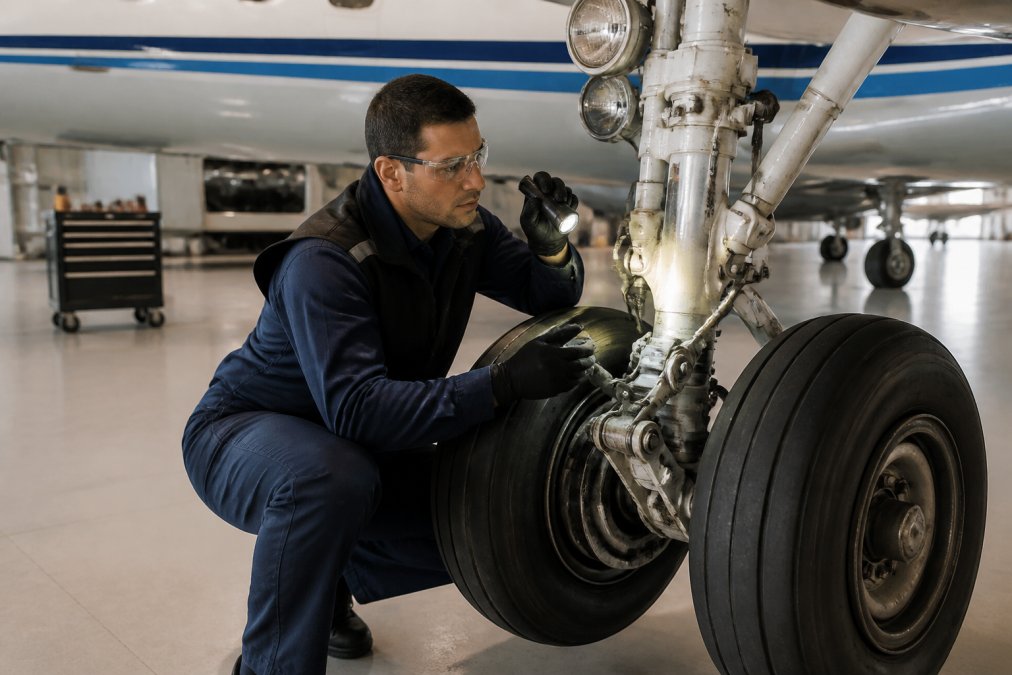
Landing Gear, Wheel Bearings, and Hydraulic System Checks
Landing gear is exposed to moisture, salt, and debris every time you land. Wheel bearings corrode quickly in humid environments. Hydraulic systems contain fluid that can trap moisture, leading to corrosion inside lines and components.
Regular inspection of these systems catches corrosion before it compromises safety or function. Your maintenance facility should be checking:
- Landing gear actuators and cylinders for corrosion and fluid leaks
- Wheel bearings for rust or pitting
- Hydraulic lines for internal corrosion (detected through oil analysis)
- Brake assemblies for corrosion on pistons and seals
- Fasteners and brackets for white corrosion (zinc oxide) or red corrosion (iron oxide)
These checks happen during your annual inspection, but proactive owners request them during 100-hour checks as well. Catching corrosion early means surface treatment or component replacement, not major structural repairs.
4. Understand FAA Aircraft Maintenance Requirements and Compliance
The FAA maintains strict rules about who can perform maintenance, what maintenance is required, and how it must be documented. Violating these rules can ground your aircraft, void insurance coverage, or result in fines.
New owners often don't realize that not all maintenance is created equal. Some work requires an FAA-certified mechanic. Some requires a specialized inspection authorization. Some can be performed by the owner under Part 91 rules (if you meet specific criteria). Getting this wrong is expensive.
Airworthiness Directives and Service Bulletins
An airworthiness directive (AD) is an FAA mandate. It's not optional. It applies to your aircraft whether you like it or not, and you must comply by the deadline specified or your aircraft becomes unairworthy.
Airworthiness directives come in different flavors. Some require one-time action (install a modification, replace a component). Others require recurring action (inspect every 500 hours, replace every 2,000 hours). Tracking them is essential.
Service bulletins, by contrast, are manufacturer recommendations. They're not mandatory unless the FAA turns them into an airworthiness directive. But ignoring service bulletins is risky, they often address issues that later become mandatory.
The difference: if you miss an airworthiness directive, your aircraft is grounded. If you miss a service bulletin, you're operating at increased risk and potentially violating insurance terms.
Logbook Documentation and Regulatory Compliance
Every maintenance action, from an oil change to an engine overhaul, must be documented in your aircraft logbook. The documentation must include:
- What work was performed
- Who performed it (mechanic name and certificate number)
- When it was performed (date and hobbs meter reading)
- Any discrepancies found or corrected
- Compliance with applicable airworthiness directives or service bulletins
The FAA inspects logbooks during audits. Incomplete or inaccurate documentation can result in violations. Some owners have faced fines for maintenance that was performed correctly but documented poorly.
This is where digital logbooks shine. They enforce documentation standards and create permanent records that can't be disputed.
5. Budget for Unexpected Repairs and Plan Maintenance Costs
The most dangerous myth in aircraft ownership is that maintenance is predictable. It isn't. You can follow every schedule perfectly and still face surprise repairs, a cracked engine cylinder, a corroded hydraulic line, an avionics failure.
Successful owners budget for both routine maintenance and unexpected repairs.
Predictive Maintenance and Oil Analysis Programs
Oil analysis is predictive maintenance. It tells you what's happening inside your engine before something breaks. Services like ALS Tribology and Pratt & Whitney's Advanced Oil Analysis use microscopic analysis to detect wear patterns, contamination, and component deterioration.
The cost of oil analysis is minimal, typically under $200 per sample. The value is enormous. Catching bearing wear before the bearing fails prevents an engine overhaul (which costs $50,000+). Detecting contamination early prevents damage to other engine components.
New owners should establish an oil analysis program immediately. Submit samples every 10-15 flight hours initially, then adjust frequency based on results. Over time, you'll develop a baseline for your specific engine and catch anomalies quickly.

Selecting a Qualified MRO and Managing Downtime
An MRO (Maintenance, Repair, and Overhaul facility) is your partner in ownership. Choosing the right one matters enormously. You want a facility that:
- Responds quickly to maintenance requests (ideally within 24 hours)
- Provides transparent pricing and communication
- Has experience with your specific aircraft type
- Offers emergency AOG (Aircraft on Ground) support
- Maintains strong relationships with parts suppliers
- Provides digital documentation and compliance tracking
The wrong MRO will delay your maintenance, surprise you with unexpected costs, and leave you scrambling when emergencies happen. At 305 Sky, we've built our reputation on the opposite approach: rapid response, transparent pricing, and expert technical care. With 24/7 emergency AOG support and four strategically located South Florida facilities, we ensure your aircraft gets attention when you need it, not when the facility has an opening.
When selecting an MRO, ask for references from other operators. Ask about their typical turnaround time for routine maintenance. Ask how they handle emergency repairs. The answers tell you everything about how they'll treat your aircraft.
Downtime is expensive. Every day your jet is in maintenance is a day you can't use it. This is why choosing an MRO that works efficiently matters. Some facilities drag out maintenance over weeks. Others complete the same work in days. The difference is often just operational excellence and prioritization.
Bonus Tip: Pre-Flight Inspections and Avionics Maintenance
Pre-flight inspections are your first line of defense against mechanical failure. Before every flight, you (or your crew) should perform a walk-around inspection: check fuel quantity and quality, inspect the exterior for damage or corrosion, verify that all doors and panels are secure, and confirm that lights and antennas are intact.
This takes 15-20 minutes and catches problems before they become airborne emergencies.
Avionics require specialized maintenance. Modern glass cockpits are complex, and their systems require certified avionics technicians to service. If your avionics are aging, budget for upgrades or overhauls. Outdated avionics create safety risks and can affect insurance premiums.
Aircraft ownership is manageable when you treat maintenance as a priority, not an afterthought. The five practices covered here, routine scheduling, digital tracking, corrosion prevention, regulatory compliance, and predictive maintenance budgeting, form the foundation of responsible ownership.
New jet owners often face a steep learning curve on compliance and maintenance logistics. That's where having the right partner makes all the difference. 305 Sky specializes in exactly this: guiding new owners through their first years of operation with transparent guidance, rapid response, and expert technical care. From 24/7 emergency AOG support to comprehensive digital logbook management and regulatory compliance tracking, we handle the complexity so you can focus on flying. Get a quote today and discover what it means to work with an MRO that treats your aircraft like their own.
Frequently Asked Questions
How often does a private jet require aircraft maintenance?
Private jets require annual inspections mandated by the FAA, plus 100-hour inspections if flown commercially. Beyond that, routine maintenance includes regular engine oil changes, filter replacements, and scheduled lubrication of the airframe. Many owners perform oil analysis every 25-50 flight hours to detect potential engine issues early. The exact frequency depends on your aircraft type, usage, and manufacturer recommendations. A qualified MRO will develop a customized maintenance schedule based on your specific jet's operating hours and condition.
What are the main FAA aircraft maintenance requirements for jet owners?
The FAA mandates annual inspections for all Part 91 aircraft and requires compliance with airworthiness directives and service bulletins as they are issued. Your logbook must document all maintenance performed, including parts replaced and technician certifications. You must also track and comply with any manufacturer service bulletins and comply with FAA airworthiness directives within specified timeframes. Failure to maintain proper documentation or complete required inspections can ground your aircraft and affect insurance coverage. Working with an FAA-certified maintenance facility ensures you stay compliant.
How does aircraft maintenance tracking software help new jet owners?
Digital maintenance tracking software eliminates the risk of losing physical logbooks and provides real-time alerts for upcoming scheduled maintenance and compliance deadlines. Systems like Veryon Tracking and Bluetail automate work order management, inventory tracking, and regulatory compliance monitoring. Cloud-based access means you can review maintenance history from anywhere, which is invaluable when selling the aircraft or dealing with insurance claims. These platforms also generate reports that demonstrate consistent preventative maintenance, which protects your aircraft's resale value and helps justify insurance premiums.
What is the difference between scheduled and unscheduled aircraft maintenance?
Scheduled maintenance includes routine inspections, oil changes, lubrication, and component replacements performed on a fixed timeline to prevent failures. Unscheduled maintenance occurs when unexpected issues arise, such as a hydraulic leak, avionics malfunction, or engine anomaly detected during inspection. Preventative maintenance reduces unscheduled downtime and operating costs by catching wear before failure occurs. Budgeting for both types is essential, most owners reserve funds for unexpected repairs while maintaining a strict schedule for routine work. Predictive maintenance tools like oil analysis programs help minimize emergency repairs.
How do I choose a reputable FAA-certified maintenance facility?
Look for an MRO with FAA Part 145 certification, which means they meet strict regulatory standards for maintenance and repair. Verify that technicians hold appropriate airframe and powerplant (A&P) certifications and that the facility has experience with your specific aircraft type. Ask for references from other jet owners and review their track record on turnaround times and transparent billing. Facilities offering 24/7 AOG (aircraft on ground) support are valuable for emergency repairs. Request a detailed maintenance plan and pricing structure upfront to avoid surprises. A quality MRO will prioritize your aircraft's airworthiness and provide clear communication throughout every service.
This article was written using GrandRanker